For quite some time now, Europe’s debate about digital sovereignty has largely revolved around one question: how do we reduce our dependence on American Big Tech?
It is an understandable concern. European governments, businesses and public institutions depend heavily on a relatively small group of US companies for cloud infrastructure, workplace software, search, social media, advertising, mobile ecosystems and increasingly artificial intelligence. That concentration creates questions around control, jurisdiction, data, resilience and economic power.
But there is a danger in defining digital sovereignty too narrowly. If Europe simply replaces American Big Tech with European Big Tech, we may change the nationality of the companies involved without solving the underlying problem. What Europe needs is not merely European technology. It needs technological diversity.
Monoculture is the real vulnerability
Hamish Campbell, who writes extensively about the open web and the Open Media Network, makes an important distinction. The problem with today’s internet is not simply that companies such as Google, Meta or Amazon have become extremely powerful. It is that digital infrastructure has developed into something resembling a monoculture.
When a small number of platforms dominate communications, infrastructure and online identity, dependency follows. Dependency gives those platforms control, while concentration makes the wider ecosystem vulnerable. Campbell therefore argues that the answer cannot be another monoculture carrying different branding.
That observation is particularly relevant to the European sovereignty debate. Imagine Europe successfully creates one major European cloud provider, one dominant European social network, one European AI platform and one European office-software ecosystem. European institutions might become less dependent on US companies, but customers could still face exactly the same structural problems: vendor lock-in, difficult migrations, concentrated market power and enormous dependence on individual suppliers. Sovereignty without diversity can simply create a different dependency.
We need an ecosystem, not a champion
Europe therefore needs to look beyond the traditional idea that every technology market requires a handful of very large “champions”.
The open web offers a different model. Instead of searching for one platform capable of replacing Facebook, X, Microsoft or Google, the objective can be to create an ecosystem in which many different services coexist and communicate through open standards.
Campbell describes the open web as something that should deliberately be messy: different technologies, organisations, communities and approaches existing alongside each other rather than converging on one supposedly perfect solution.
That messiness may actually be an advantage. A healthy digital ecosystem could include commercial companies, open-source projects, cooperatives, universities, public infrastructure providers and thousands of smaller hosting and software businesses. Some might operate locally, others internationally. They would not necessarily use identical technology, provided that open standards and interoperability allow users and information to move between them.
The comparison with biodiversity is obvious. An ecosystem containing many different species is generally more capable of adapting when circumstances change than one dominated by a single organism. Digital infrastructure deserves the same thinking.
Federation alone is not enough
The Fediverse demonstrates some of these possibilities. Instead of one company owning the entire social network, independent servers can communicate through common protocols such as ActivityPub. But decentralisation at the technical level does not automatically guarantee decentralisation in practice.
Campbell warns that federated systems can decentralise servers while gradually recentralising culture, governance and influence. The challenge is therefore not simply scaling the infrastructure. Communities, governance structures and shared social infrastructure must scale with it.
That lesson should be taken seriously in Europe. Building alternatives to hyperscalers is not enough if those alternatives eventually follow precisely the same path: consolidation, acquisition, platform concentration and lock-in.
Dependency is remarkably difficult to escape
There is another reason diversity matters. Once a platform becomes deeply embedded in everyday economic and social activity, leaving becomes increasingly difficult.
A small business may depend on Instagram to reach customers. A community organisation might coordinate activities through Facebook. Friends and families may communicate through WhatsApp. Companies can build entire business processes around one cloud provider. Campbell describes this as an infrastructure problem rather than simply an individual choice. People cannot easily leave dominant platforms when everyone and everything they need remains there.
Twenty years of platform dominance have therefore created something much deeper than market share. They have created habits, dependencies, technical architectures and network effects that reinforce one another.
Sovereignty should mean having choices
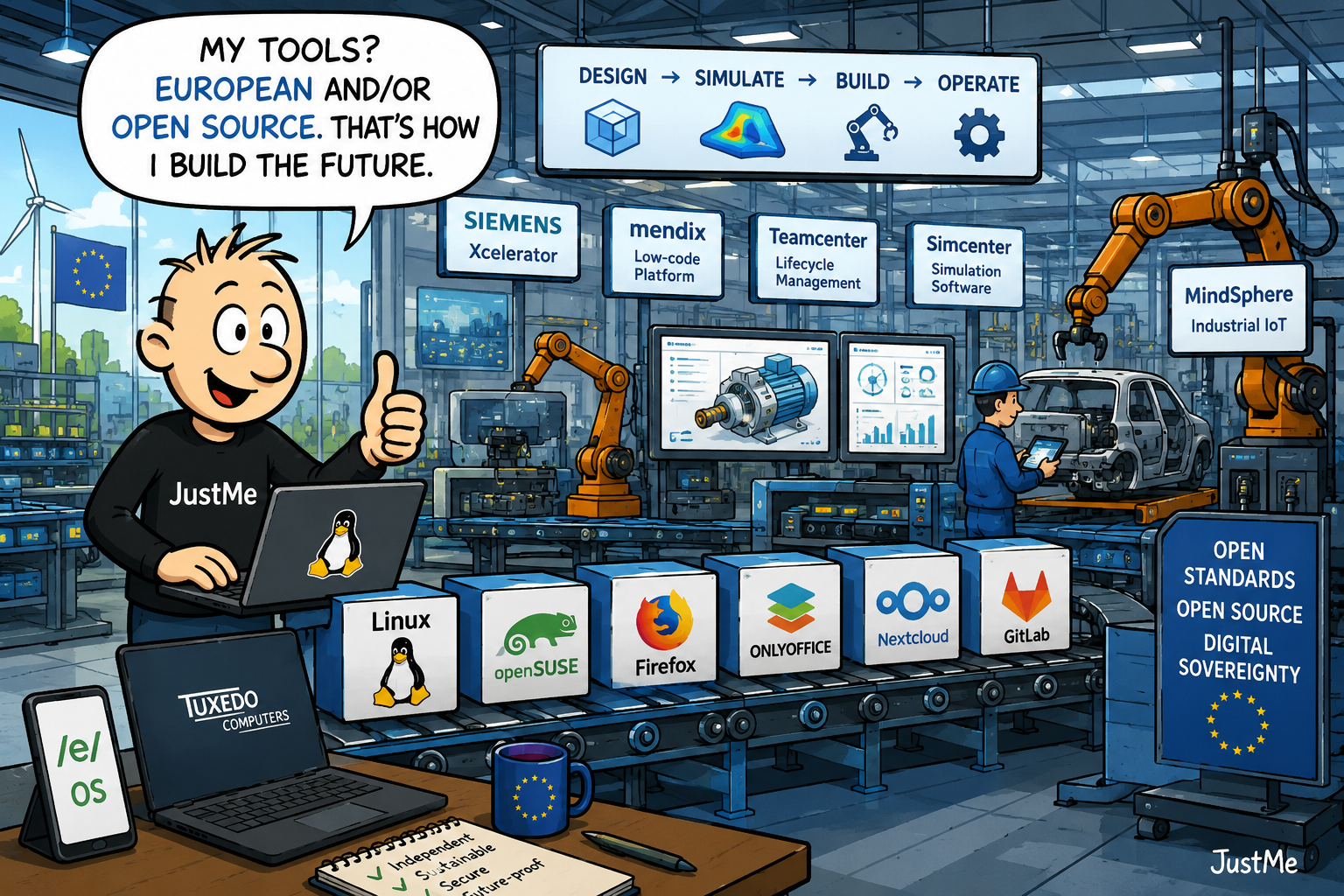
This changes the meaning of digital sovereignty. True digital autonomy should not mean that every server, application or cloud service must carry a European flag. Nor should it mean creating European equivalents of every American hyperscaler.
It should mean that organisations retain meaningful choices. They should be able to change providers without rebuilding their entire IT environment. Data should be portable. Standards should be open. Different platforms should interoperate. Open-source alternatives should remain viable. Smaller providers should be able to participate without first becoming hyperscalers themselves.
The strategic objective should therefore be bigger than replacing Big Tech. Europe needs an internet and technology industry where no single company becomes indispensable in the first place. Because the strongest form of digital sovereignty is not owning the next hyperscaler. It is not needing one.